

Business activities, News
Dietary fat and oxidation
03
Jun
Jun
Adding fat to food in the summer is a common practice to increase calories but if it is oxidized by heat or preservation, is this a concern?
Doctor. Jerry Shurson, Department of Animal Science, University of Minnesota, St. Paul; Brian Kerr, USDA-Agricultural Research Laboratory – National Laboratory for Agriculture and the Environment, Ames, Iowa; Chi Chen, and Pedro Urriola, Department of Food Science and Nutrition, University of Minnesota, St. Paul

Fats and oils are often added to pig diets, especially in the summer, to increase calorie content and maintain energy consumption in hot weather. To capture these benefits, producers need to know how to appreciate and conserve the energy value of these ingredients.
Sources of animal fats and vegetable oils, such as tallow, cooking oils, highly unsaturated vegetable oils (corn and soybean oils) and animal-vegetable oil blends will vary in composition. fatty acids and oxidation state, both of which will affect the caloric value of the diets fed to pigs.
In fact, a survey of the US feed industry conducted between 2000 and 2005 by Novus International found that 40 to 50% of fats and oils (e.g. poultry fat, tallow, white fat, canola oil, corn oil and soybean oil) used in animal feed have been significantly oxidized, especially during the summer months. Results from this survey showed that samples with peroxide (PV) values as high as 180 meq/kg of fat from April to June, and many samples with PV > 10 meq/kg of fat, were considered oxygenated. significantly.
Much of this can be attributed to the heat-treated fats in the feed, as well as the long-term failure to clean the fat tanks in feed mills. Therefore, assessing the extent of oxidative damage in supplemental fats and oils should be a priority in pig feeding programs.
How do we determine the quality of fats and oils?
Various methods are used to assess the quality of fats and oils in the feed ingredients market. Unfortunately, the most common methods of quality assessment (e.g. color; pour point of saponified fats; moisture, insoluble, and unsaponifiable content – MIU; and function) amount of free fatty acids) does not accurately describe the extent of oxidative damage.
When unsaturated fatty acids are exposed to high temperature, oxygen and transition metals (e.g. copper, iron, zinc) during processing and storage, peroxidation and secondary degradation take place. out quickly. This degradation forms lipid oxidation products (LOPs) at different stages of processing.
When LOPs are present in the diet in significant amounts, they can cause adverse effects on growth performance and may be toxic to animals. Many types of LOP have been identified in oxidized oils and fats, including peroxides, cyclic and hydroxylated fatty acids, reactive aldehydes, and various polymers. Therefore, a single chemical analysis is not sufficient to determine the presence and concentration of LOPs, and their relationship to pig performance and growth health.
Among the available oxidation indicator tests, the PV indicator for the measurement of peroxides, thiobarbituric acid reactants (TBARS) and mainly for the measurement of malondialdehyde will be the most commonly used. However, these methods measure only selective LOP and do not provide a comprehensive assessment of all LOPs in grease.
In fact, establishing an accurate and comprehensive analysis of lipid oxidation, as well as understanding the underlying mechanisms underlying the adverse effects of LOP on pig performance and growth health, is an essential issue. active research in the pig production industry.
Does feeding oxidized fats affect pigs?
Feeding pigs diets containing oxidized fats can reduce growth performance, induce oxidative stress, damage the antioxidant system, as well as impair intestinal integrity and function. A summary of 8 published studies involving 23 comparative trials evaluating the effects of feeding pigs with oxidized fats on growth performance responses in pigs is shown in Table 1. Although the results Results showed an inconsistent response, and possibly due to the degree of oxidation and the amount of lipid added to the diet, 78% of the studies showed a reduction in mean daily weight gain, 74% showed an average intake. daily average decreased, and 61% reported a decrease in efficiency achieved.

Overall, the ADG, ADFI, and G:F indices decreased on average by 9%, 6%, and 3%, respectively, but the range of percentage change in ADG reported in these studies was +5% to – 35% and +6% to – 16% for the effect to be achieved. Much of this variation in growth yield response may be related to lipid source, as well as temperature and duration of heat exposure.
Furthermore, serum vitamin E levels were consistently reduced by feeding with oxidized fats with an average reduction of 46% compared with pigs fed diets containing non-oxidized fats. This suggests that feeding oxidized fats to pigs can significantly reduce the vitamin E status of pigs, and compromise their ability to cope with oxidative stress.
Do oxidized fats have any other adverse effects?
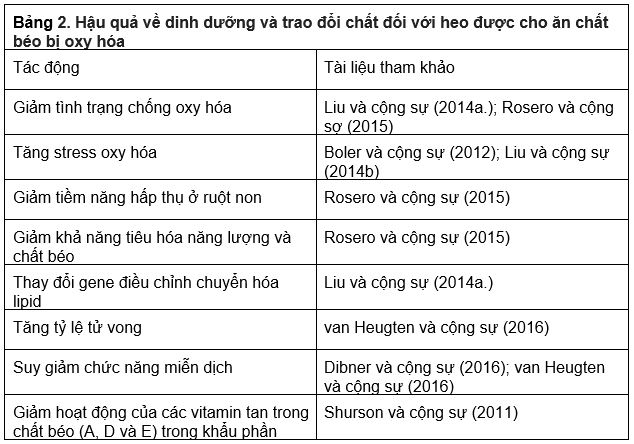
Published information is limited on the nutritional and metabolic effects and response mechanisms from feeding oxidized fats to pigs. Most of these reactions are shown in Table 2, which is not consistent across all studies.
However, there is some evidence that when pigs eat oxidized fat, there is a decrease in antioxidant status, which can lead to oxidative stress. Furthermore, lipid oxidation has been shown to reduce energy content and fat digestibility, alter lipid metabolism, and possibly reduce the small intestine’s ability to absorb nutrients.
Feeding with oxidized fats can decrease immune function and increase mortality. Finally, exposure of fat-soluble vitamins (e.g. vitamins A, D and E) to oxidative conditions reduces their concentration and activity in premixes and diets.
How can we prevent lipid oxidation?
Consideration should be given to using commercially available synthetic antioxidants to prevent lipid oxidation (although they do not reverse or eliminate any LOPs). Common antioxidants added to fats, oils and other lipid-rich feed ingredients include ethoxyquin, TBHQ, propyl gallate, BHA and BHT.
Fat storage tanks at feed mills should be cleaned, at least quarterly, to remove both oxidizing deposits and oxidizing agents that accumulate at the bottom of the tank.
Prevents prolonged exposure of high-fat ingredients and rations to high temperatures, air, and humidity by minimizing storage and inventory times.
Conclude:
The quality of fats and oils used in swine diets should be an important factor in commercial pork production systems to optimize caloric and nutritional efficiency, and minimize adverse effects. of oxidative stress, immune function and overall health of pigs.
Now, an understanding of the best analytical measures to use, the “safe” content of LOP in swine feed, and the predictability of reduced performance in growth and health from feeding pigs high quality Oxidized fat is not well defined. Collaborative efforts between researchers, feed nutritionists and pork producers are needed to find practical solutions to help manage lipid quality and avoid negative effects potential in pork production.


